Photo by Strikepoint News Wire, QuoteMedia data on Pexels
For anyone trading the TSX Venture Exchange (TSXV) right now, opening the market scanner feels less like preparing for a trading session and more like checking a casualty report. The sentiment across Canada’s junior exchange is palpable: it is heavy, suffocating, and dripping with doom and gloom. If you are a day trader trying to extract a living from this fragmented, micro-cap graveyard, you already know the brutal reality. Liquidity is drying up faster than a desert puddle under a July sun, spreads are widening to ridiculous degrees, and the once-reliable momentum plays have devolved into liquidity traps designed to fleece the unwary.
Insert the James Franco “First time?” meme here. You know the one.
Yet, this is precisely what we signed up for. Day trading the TSXV has never been for the faint of heart, but the current macro-environmental squeeze has turned a difficult game into an absolute survival test. To understand why trading this market feels like walking through a minefield, we have to look at the broader picture, starting with the relentless beating being handed to the commodities that fuel this exchange.
The Commodity Collapse: The Lifeblood Drains Away
The TSX Venture is fundamentally a commodity-driven index. Unlike the senior TSX, which boasts heavy-hitting financials, telecoms, and pipeline giants, the Venture is heavily populated by early-stage mining explorers, junior energy firms, and green tech speculative plays. When commodities thrive, the Venture roars, capital flows effortlessly into overnight placements, and day traders can feast on massive gap-ups driven by high-volume drill results or soaring spot prices.
The Radar in your inbox before the open: the drill results and discoveries that can move a junior, ranked, plus a few pieces a week from people who trade them.
Right now, that engine is stuttering and coughing black smoke. Across the board, key commodities have faced severe downward pressure. When the broader market loses its appetite for risk, junior mining stocks are the absolute first things to get thrown overboard by institutional funds and retail speculators alike.
For a day trader, this commodity downturn translates directly into a lack of follow-through. You spot a junior copper explorer flashing on your pre-market scanner email because of a high-grade intercept announcement. In a healthy market, that stock opens up 20% and grinds higher all morning as retail FOMO kicks in. In today's market? It gaps up 5%, meets an immediate wall of institutional or bagholder selling, stalls out within ten minutes, and bleeds red for the remainder of the session. Trying to trade long-side momentum in a falling commodity environment is the equivalent of swimming upstream against Niagara Falls. Every breakout feels fake, and every support level is viewed by the market not as a floor, but as a temporary speedbump on the way lower.
The Critical Battleground: Staring Down the 840 Support Level
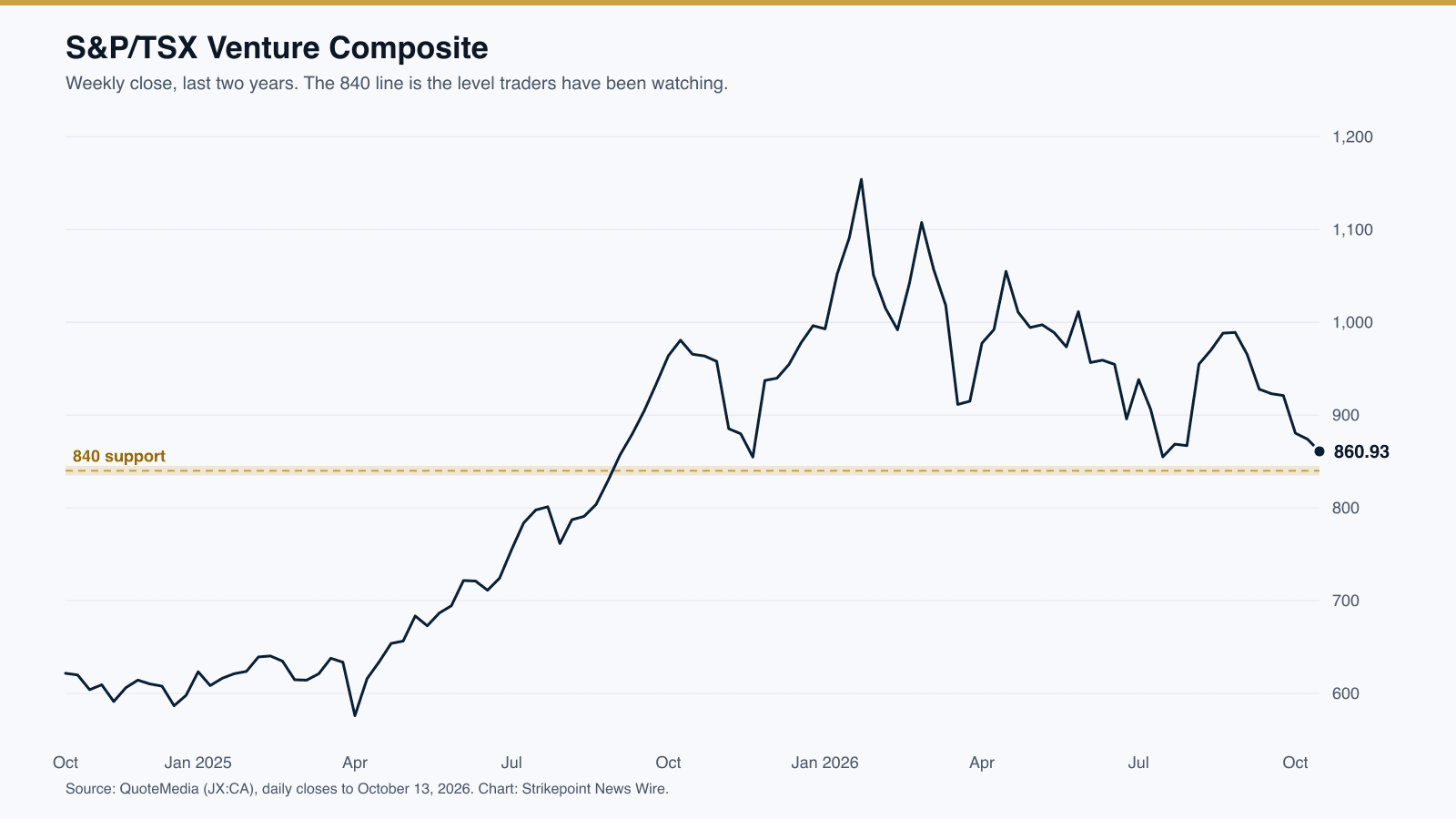
Amidst this sea of red and deteriorating sentiment, technical analysis becomes either your best friend or your worst enemy. If you pull up a multi-year chart of the TSXV index, one level screams out at you from the monitor: 840.
This level is not just a random line drawn on a chart; it is a psychological and structural line in the sand. Over the past 6 months, the 840 zone has acted as a formidable demarcation point, absorbing heavy selling pressure and triggering aggressive bounces in past corrections. Day traders and swing traders alike have locked their lasers onto this specific handle.
Right now, the index is hovering dangerously close to this critical threshold, and the tension in the trading community is palpable. We are standing at a classic crossroad, and the market's reaction here will dictate our playbook for the coming months.
Scenario A: The Breakdown
If macroeconomic pressures intensify and the 840 support level gives way under sustained selling pressure, the psychological impact could be catastrophic. A definitive, high-volume break below 840 opens a technical vacuum. Without any significant historical support immediately below, a breakdown could trigger a cascading wave of margin calls, forced liquidations, and absolute capitulation among junior resource companies. For day traders, this scenario requires a complete pivot. You must instantly shelve any remaining bullish biases and learn to master the art of shorting or simply stay in cash and protect your capital from the collateral damage.
Scenario B: The Defensive Bounce
Conversely, markets rarely move in straight lines, and extreme pessimism often breeds sharp, violent counter-trend rallies. If buyers step in right at the 840 threshold, defending the line with institutional muscle, we could witness a powerful relief rally. In this scenario, oversold junior mining stocks could experience explosive, short-covering bounces. For nimble day traders with lightning-fast execution speeds, trading a successful bounce off 840 offers immense upside potential. The key here is agility: you cannot fall in love with these stocks. You buy the panic, you ride the wave of forced short-covering, and you take your profits off the table before the broader downtrend resumes.
Black Gold in a Sea of Red: Oil as a Glimmer of Hope
While the broader commodity complex looks bruised and battered, every storm cloud has a silver lining. For the TSXV trader searching for a beacon of light amidst the gloom, that glimmer of hope is coming from an unexpected corner, oil.
While metals and speculative tech plays struggle, energy markets have demonstrated remarkable resilience. Persistent geopolitical tensions across key producing regions, ongoing supply discipline from major global producers, and resilient global demand have kept oil prices supported at levels that would have seemed like a pipe dream a decade ago.
This strength is quietly bleeding into the energy subset of the TSX Venture. While the junior mining space suffers from capital starvation, junior oil and gas producers and explorers that boast solid free cash flow, clean balance sheets, and active drilling programs are actually catching bids.
For day traders, this is where the actionable opportunities lie right now. When the general index is lagging, sector rotation is your playbook. Instead of banging your head against the wall trying to trade a broken gold explorer, shifting your focus to high-relative-strength junior oil producers allows you to trade with the wind at your back. Oil is proving that capital hasn't entirely fled the exchange; it has simply migrated away from dead weight and concentrated itself in sectors with actual, tangible cash flow and structural tailwinds.
Surviving the Grind: A Day Trader's Survival Guide
Trading the TSX Venture during a prolonged macro slump requires a psychological shift. The strategies that worked during the speculative euphoria of past bull markets will actively destroy your trading account today. If you want to survive and keep your trading account green while the broader index flirts with disaster, you must tighten your discipline.
First, position sizing is everything. In a low-liquidity environment, slippage is your silent killer. Getting stuck in a micro-cap name with a wide bid-ask spread when the market turns south can turn a manageable stop-loss into a catastrophic account drawdown. Scale down your size, and never chase parabolic moves in illiquid stocks.
Second, embrace cash as a position. There is an old saying on Wall Street that cash is a position, and on the TSXV right now, it is often the best position. You do not need to trade every single day. Sitting on your hands and waiting for clear, high-probability setups around the 840 support pivot or high-relative-strength oil plays is a sign of professional maturity, not weakness.
Finally, manage your mental capital. The doom and gloom of the current market state can easily bleed into your mindset, causing revenge trading, over-trading, and frustration. Remember that markets are cyclical. Bear markets create the seeds of the next great bull run, and the discipline you forge during these difficult conditions will pay massive dividends when the tide finally turns back in our favor. The good times will be back eventually.
Until then, keep your stops tight, watch that 840 line like a hawk, and follow the money into the energy plays that are keeping the lights on in an otherwise dark room. Good luck out there you're going to need it.